

Tipping Point
A geography of where time stands still.

This story was selected as the Audience Favorite for the Vagabond edition of Cassettes! Hopefully I will return to the tipping point soon, since I initially conceived of it as a framing device for a short story collection. For now, Doc Moorley embarks alone in his adventure…
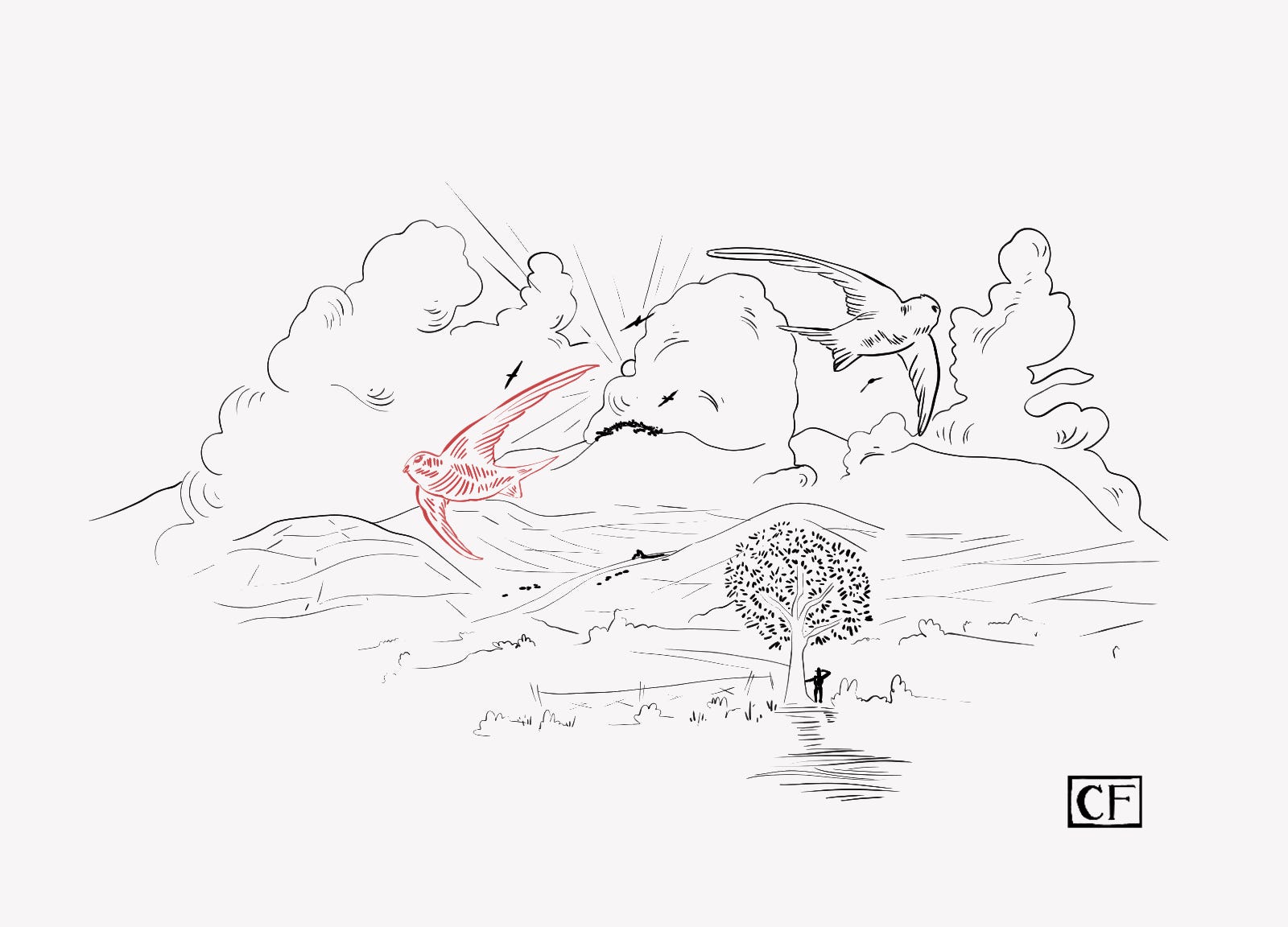
et me tell you about Doc Moorley. He’d always been frustrated by this copse of trees at the top of that hill, they stuck out from the top of Tipping Point like a tuft of uncombed hair. It’s all surrounded by perfectly good land, arable-like. The wheat shines bright gold, the barley’s a’singin’ green in summer; and those dark trees were unwelcome as a dissonant note in his otherwise perfectly-tuned town. A waste of space! he’d proclaim, regularly.
Doc Moorley wasn’t a farmer himself, but he was a man of the land, by which I don’t allude to the fact that he owned land (which he did), but rather that he knew his way around this entire countryside like the back of his hand. So he could tell you how to get from any point A to any point B, and all the way through to Z, and back again. But no one went up to the top of Tipping Point, and so he’d never had the occasion to tell anyone, let alone himself, at which point it was, that is, how to get there. No one had ever been, though, wandering or otherwise, which no one questioned because there was no particular reason to go.
That was the thing with Doc Moorley though: he was a man who made reasons for things. That’s not a quality you get in many folks; most people need reasons to do things, but few make their own reasons. Lots of trudge, no track. Not for Doc, though, and certainly not when it came to the dark copse of trees of Tipping Point.
We could get X yield out of acreage like that, he grumbled for the unnumbered time. It should be noted that this grumbling was not out of greed, but a true practicality combined with a vanity deeply tied to the aesthetics of fields. Yield was a reason unto itself (though not a reason he made for himself, which came soon after).
X yield is fine and good but cutting down all those old trees seems more trouble than its worth, said everyone. It should be noted that this dismissal was not out of laziness, but: a preternatural disinterest in the copse of trees which seemed to mark everyone but Doc; and a grateful satisfaction with the yield they already had. Why would we bother all the way up there, anyway, look at how golden our wheat shines, how green our barley sings.
Doc, though sensitive to shining and singing, could not wash the dark blot from his line of sight.
At the end of one particularly hot summer’s day, Doc was having a cool beer down the pub, as was everyone, as well as a new someone who was passing through.
What a lovely town this is, this someone said, how green and gold the fields! And so flat all around, such good earth for tilling—but for that funny hill and its copse of dark trees!
Ah, Tipping Point! said one of Doc’s neighbors.
Over the lip of his pint, Doc’s words spilled out to this strange someone. Do you want to know how to get to Tipping Point? he said.
Oh well I passed it on my way here—
Not the base, said Doc. The top. The tipping point.
Well that’s not really on my way—
Sure you don’t? I can tell you. I can trace any point to any point around these parts. You’ve only got to ask and I could tell you.
I’m sure that’s very kind of you sir—Doc, was it?—but I’m not sure I’ve any need.
And so the question wasn’t asked, and so somehow, Doc found for the first time that he didn’t quite know. Maybe if someone had just asked, Doc would have been able to pull it from the air as he did all other point-to-point directions; but it so happened that the unasked-for directions stayed misty in his mind and he could only think of other points: the whole road circumventing the hill, and many gates and bushes on the shoulders of the hill, even a particularly attractive tree three-fourths of the way up, and a rabbit hole up near the edge of the trees. Points swarmed around his head, but none were the Tipping Point.
Maybe he didn’t realize it, but Doc began to ask himself the question, How does one get to the top of Tipping Point? And the more he asked, the more he was sure he did not have the answer. This baffled him, because surely if you simply walked towards and then up, you’d get to the top; but the more he plotted points in his mind, the more he felt this to be profoundly untrue.
As he left the pub, Doc started down the road towards his house and found himself on the totally wrong edge of town, passing the washhouse and the old orchard instead of the little chapel and the common well, tripping over his shoelaces all the while, until he realized he’d muddled up every point in his mind-map while ruminating over Tipping Point.
While Doc unties his thoughts from Tipping Point to tie his shoelaces, let me take a moment to clarify some things:
This story is totally untrue, although if you’re presently hearing it, it must be possible;
If you’re hearing this now, you’ve necessarily been to Tipping Point, though you probably couldn’t give directions to it any better than Doc Moorley;
I, however, could tell you exactly how to get there.
If you were to start combing through the underbrush to find the cairns spangling the hill just before dusk, and really kept at it until past nightfall, and added a stone to each pile you found, you would eventually and then very suddenly come to a break in the trees crowning the upper part of the hill, although you would not have been walking particularly upwards, more often across or downwards. That is, if you ignored the wisps of light at the edge of your line of sight, and if you paid no mind to the gossiping owls and blustering nightingales, and you paid no mind to your tightening chest while counting every breath you took; only when all of the stars in the sky were out, yet piercing giant towers of indigo clouds lit up by a waxing gibbous moon might; and even then—
Where this runty hill kisses the very bottom of the sky, birds fly over and over and never leave, and never land.
Doc Moorley’s shoelaces being tied, he’d watch the birds fly overhead, having taken the path I found to Tipping Point, or his own, I couldn’t say just now.
Do you want to know how to get to Tipping Point? I’d say. You must have passed it on your way here. Not the base, the top. The tipping point. Was it not on your way? Are you sure you don’t? I can trace any point to any point around these parts. You’ve only got to ask and I could tell you, if you’ve any need.
You must’ve noticed the hill down the road, maybe you thought of it while I was telling you this story. No? I would point it out to you now, set you back on your way, since during the day you can see it through that window, but it’s a new moon tonight and real dark out.
If you were to point out of the window, to the smudge in the sky above our blessed horizon of fields and farms and forest, and ask, Isn’t that the Tipping Point, I’d tell you the story of Doc Moorley, who also spoke of funny things and came into town all funny one morning and has been funny since, or wasn’t he always a bit odd?